Showing posts with label NASA. Show all posts

They note that the program is insufficient against asteroids

NASA's plan to protect Earth from the planetoids is running late. Urge manage the program according to the requirements. The agency proposed corrective action. 

The NASA program to detect and protect the Earth from asteroids that can reach it is poorly managed and backward with respect to their objectives, according to a government audit published in the United States. 

Only a million dollars of the total budget of the agency, which is 40 million spent on strategies to deflect asteroids when will impact the Earth or evacuate endangered areas, says the report by the inspector general of NASA, Paul Martin. 

NASA has struggled to find dangerous asteroids

An order from the United States Congress tells NASA should find 90% of the potentially hazardous asteroids near and exceeding 140 meters in diameter. However, the Inspector General of the space agency, Paul Martin, acknowledged Monday that they feel unable to meet the target. 

"NASA has identified estimated that only 10% of all asteroids 140 meters or more," Martin said. "Given the pace and current resources," the agency "will not meet the goal of identifying 90% of these objects in 2020." 

The report by Martin claims that NASA's efforts are poorly coordinated, poorly managed and understaffed, as a one-person office directs "somewhat structured that are not well integrated and that also lack the research cluster needed to monitor progress "supervision. 

NASA has Orion capsule intended to explore deep space

The Directors of the National Aeronautics and Space Administration (NASA) of the United States today introduced its new Orion spacecraft with which hopes to explore deep space in 2021. 

The ozone layer shows signs of recovery

A study by UN found evidence that the ozone layer, which protects the Earth from ultraviolet rays, beginning to recover after years of decline. 

Scientists believe that good news is a result of global tax veto in the early 80s to the chlorofluorocarbons (CFCs), chemicals used in refrigerators and aerosols. 

The report's authors say that this is an environmental success story thanks to international action and that the same level of urgency and unity should be directed to address climate change. 

Astronauts and cosmonauts leave the space station heading to Earth

Two Russian cosmonauts and a NASA astronaut left the International Space Station on Wednesday toward Earth after nearly six half in orbit. 
The former commander of the space station Steve Swanson and cosmonauts Alexander Skvortsov and Oleg Artemyev were clamped in the Russian Soyuz capsule that took them to the station in March and was separated from the platform at 23:01 GMT when the artificial satellite was 418 km over eastern Mongolia. 
"We get a lot., We had so much fun," Swanson said during a change of command ceremony Tuesday that broadcast television NASA. 

On clear skies, the last superluna 2014

Last year superluna was observed from sunset on the region, with greater relative size and brightness for being a shorter distance from the earth. 
According to connoisseurs, Tuesday September 8 satellite was observed 14 percent bigger and about 30 percent more effulgent. The same effect was observed on 12 July and 10 August previous.

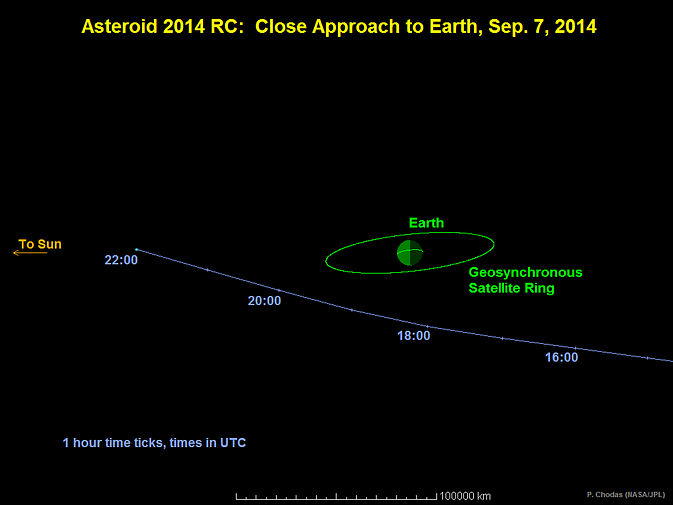
The asteroid '2014 RC' passed close to Earth safely, according to NASA

A small asteroid the "size of a house" Sunday went "very close" to Earth without posing any danger to the planet, NASA said. 

"Nothing to worry about, is 40,000 kilometers," the American space agency on its Twitter account at the time of the passage of the asteroid about 20 meters in diameter, the "vicinity" of the Earth. 

According to NASA calculations, the time of closest approach to Earth asteroid, dubbed "RC 2014" was at 14:18 hours on the east cost of the United States (18:18 GMT), when it passed over New Zealand as the nearest point. 

The celestial body was discovered on Aug. 31 by the Catalina Sky Survey (CSS) program, operated by the Lunar and Planetary Laboratory, University of Arizona, which uses data from three telescopes to search for comets, asteroids and near-Earth Objects . 

This was confirmed by NASA, which said that does not represent a serious threat. You will travel about 40,000 km of the globe, and its highest point is about the New Zealand approach

According to NASA, this Sunday an asteroid the size of a house, will pass about 40,000 km from Earth. That is, just over a tenth of what is the distance between Earth and the Moon. 

The asteroid named 2014 RC, although it is small to see without any instrument, might be visible using a telescope, he said the U.S. space agency. 

NASA also predicted that the object will travel a distance of approximately 25,000 miles (40,000 kilometers) from Earth. 

Please note asteroid about 20 meters will "close" to Earth this Sunday

Attentive to what's coming: According to recently reported NASA heavenly body said insurance will not impact the planet and "not appear to pose any danger" either. Recall that its orbit would bring him back in the future and their movements will be monitored closely to keep in mind. 

There is no doubt that an asteroid is always cause for attention astronomer community and as such reactions are happening on the possibility to see it or not. 

A small asteroid will pass only about 20 meters "very close" to Earth on Sunday, NASA said today that any discarded posing a threat to the planet Earth. At its closest proximity, right at 14:18 (ET Time) September 7, can be seen from Earth. 

An asteroid will pass close to Earth on Sunday

The scientific community will have this weekend a great opportunity to observe and learn more about asteroids, and one recently discovered small pass near Earth provide, without causing damage. 

The "RC 2014", which is about 20 meters, was detected Sunday by the Catalina Sky Survey (CSS) program, operated by the Lunar and Planetary Laboratory, University of Arizona (USA), which uses data from three telescopes to search for comets, asteroids and near-Earth objects. Hours after he was spotted by other telescope in Hawaii. 

NASA announces mission to Mars in 2020

This is the mars rover 2020, an expedition that will evaluate for sure if the Martian atmosphere is conducive to life humana.El project will have a new model called rover 2020 spacecraft, which will be equipped with the highest and appropriate technology. 

"The Mars Project 2020 will help resolve questions about the ecosystem and the environment Martian astronauts questions that have for decades. The rover will allow testing and experiments that give us accurate information even before the return of the red planet rover "said William Gerstenmaier, human administrator of NASA space operations.

Photos: Unpublished images courtesy of NASA supernova

NASA commemorates 15th anniversary of the launch of the Chandra Observatory, with the publication of unpublished images of supernovas
NASA released new images of supernova captured by the Chandra X-ray Observatory, a satellite that has a mission to study the depths of the Universe. 

And is that just 15 years ago, NASA launched the Chandra space that along with the Hubble telescope, space research revolutionized their images, as published on website Gizmodo. 


Despite failures, NASA considered a successful experiment parachute

NASA tested new technology designed to carry a spaceship, and someday-even astronauts safely to Mars. Reliance stated that the experiment was a success despite a parachute tangled during descent. 

Proof of $ 150 million held yesterday, is the first of three to be submitted to the Supersonic Decelerator Low Density vehicle. The testing is being done at high altitudes on Earth simulating a descent through the thin atmosphere of the Red Planet. 


A total mystery island that comes and goes on a moon of Saturn

scientific community is intrigued by an object that appears and disappears at sea on Titan, the planet's largest moon Saturno.Los researchers, finding an explanation of this phenomenon, they named the object as an "island". 


This "island" that comes and goes, was captured a year ago by the Cassini spacecraft of NASA in one of the seas of methane and ethane on Titan, an area that previously had been analyzed by Cassini, but had found no record subject to subsequent overflights. 


NASA seeks to capture an asteroid in 2019

NASA says it will start a mission to capture an asteroid in 2019 to obtain information from cosmic planet's past.
The National Aeronautics and Space Administration announced that the first phase of the plan to capture an asteroid in space and send it to lunar orbit for study starting in 2019 when a spacecraft is launched, reports the agency portal 'Nasa . gov. '

science and technology( NASA plans to catch asteroids)

WASHINGTON - NASA is focusing attention on the asteroids you want to capture and then carry them around the Moon and astronauts make the visit to studies.

Space agency officials described on Thursday an excellent candidate: a small asteroid passed about 12,230 kilometers (7.600 miles) above the Earth in 2011.

With 6.1 meters (20 feet) in length, is "the size of a delivery truck; in fact this asteroid could put in a garage, "said Michael Mommert, an astronomer at Northern Arizona University who studied the rock, which is named 2011 MD.

There was underground ocean moon of Pluto

According to a new NASA study, the cracks in the icy surface of Pluto's moon Charon could reveal whether inside was warm enough to maintain a subsurface ocean of liquid water.

Pluto is a distant world that orbit around the Sun is 29 times farther than Earth. The environment on Pluto and its moons is too cold, 380 degrees Celsius, enough to have liquid water on its surface.